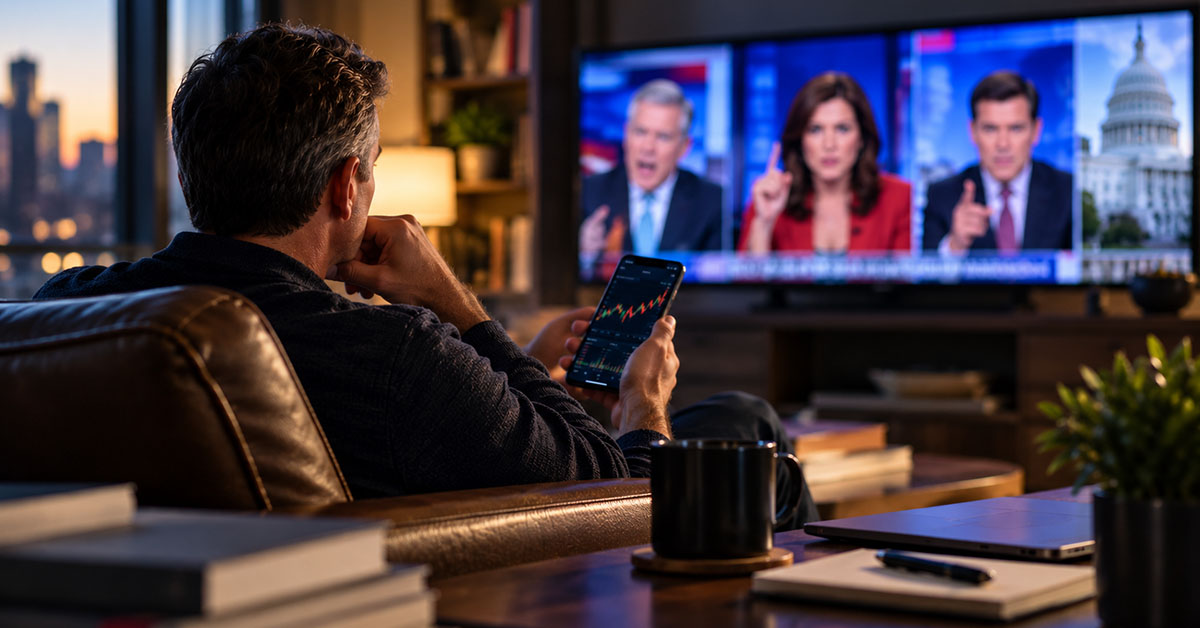
It’s still August, still hot, and still noisy. Now that the midterm elections are just two months away, the bombardment of overconfident predictions of gloom or doom or morning in America is moving into overdrive.
Investors may have noticed a shift this year; something seems different. And it is: the machine producing that overconfidence is changing into something very different.
For decades, the outrage/prediction/action machine was simple. Media companies didn’t sell news, they sold attention. Campaigns didn’t sell policies, they sold urgency. Social platforms didn’t sell conversation, they sold engagement. None of this was a conspiracy; it was an incentive structure. Understanding that was the first step toward not being managed—or fooled—by it.
Attention Was the First Business Model
A news organization’s revenue depends on how long you stay and how often you return, not on how well-calibrated your understanding of the world becomes as a result. A calm, accurate, appropriately hedged story about gradual policy change competes for the same airtime as a dramatic, urgent, definitive-sounding one. And it loses, every time, because attention gravitates toward threat and certainty, not nuance. Outrage and alarm are cheap to produce and reliably profitable to distribute. Calm accuracy is expensive to produce and difficult to monetize. Guess which one an entire industry has been optimized, over decades, to manufacture at scale.
Charlie Munger spent a career pointing out a basic truth: show me the incentive, and I’ll show you the outcome. Apply that lens to this question of incentives and the pattern in political and financial media stops looking like a mystery and starts looking like simple economics. A campaign has every reason to convince you the stakes have never been higher, because urgency drives donations, drives turnout, and drives attention. A financial commentator has every reason to connect today’s market move to today’s political story, because a causal, dramatic explanation earns more engagement than an honest “markets moved for reasons that aren’t fully knowable in real time.”
None of this is a flaw in the system. It is the system, functioning exactly as designed. The mistake is expecting a system built to maximize engagement to also, coincidentally, maximize your understanding.
That machine hasn’t gone anywhere. But a newer one has grown up alongside it — one that claims to have finally solved the problem the old machine never could.
Money Was Supposed to Fix This
The prediction industry’s newest tool claims to have solved the incentive problem entirely. Platforms like Kalshi and Polymarket let people trade real money on the outcome of elections, Fed decisions, and virtually anything else with a knowable resolution date.
The pitch is straightforward: a pundit risks nothing for being wrong, but a trader risks cash. Skin in the game, the theory goes, should produce better outcomes than a talking head with a television contract and nothing on the line.
There’s real evidence behind the pitch. One study of thousands of political prediction markets found Kalshi’s odds were accurate roughly 78 percent of the time on the eve of an election. That is a genuinely strong number, and these markets have tended to outperform traditional polling specifically on high-profile, high-liquidity races, where enough money and attention are in play to make the pricing meaningful.
At a glance, it seems as if the old machine’s problem might actually be fixed: replace performative confidence with priced confidence, and let real financial consequences do the disciplining that professional reputation risk could not.
On closer inspection, the advantage doesn’t hold everywhere. It shrinks, and sometimes disappears, in smaller and down-ballot markets, the ones with thin trading volume, where a handful of large bets can move the odds more than genuine information does. And a newer complication has emerged that has nothing to do with liquidity at all.
The Trader Might Not Be Human
The complication is this: a meaningful share of the money now flowing through prediction markets doesn’t belong to people at all. Reporting on Polymarket has found that more than 30 percent of active wallets are believed to be operated by AI trading agents rather than human traders—bots running continuously, arbitraging between platforms, executing strategies with no fatigue, no emotion, and no need to sleep.
Kalshi itself has reportedly deployed an internal AI system to help decide which markets to launch in the first place, scanning news and competitor activity to spot opportunities faster than a human analyst can.
That’s a real problem for the “skin in the game” argument, although not an obvious one. The case for prediction markets was never just “money is on the line.” It was “money is on the line, held by people with genuine, often hard-won information, who lose something real if they’re wrong.” An algorithm optimizing a pattern doesn’t hold information in that sense. It holds a strategy, and a strategy can be well-informed or it can be confidently, systematically wrong at scale, the same way a bad model can be. Money changing hands doesn’t guarantee wisdom changing hands along with it.
The mechanism has also produced integrity problems the old machine never had to worry about. Kalshi has suspended the accounts of users who turned out to be congressional candidates wagering on their own races, exposing a conflict of interest baked directly into the platform’s design. The U.S. Senate has since barred its own members and staff from trading on prediction markets tied to federal policy. These are the failure modes of a genuinely new mechanism, not the old ones wearing a disguise, which is itself a sign of how young and unsettled this corner of the prediction economy still is.
Same Wall, Newer Paint
Step back, and a pattern emerges that spans every version of this machine, old and new. The pundit, the campaign strategist, the polling aggregator, the prediction market, and now the AI agent trading inside that market are all, in the end, attempting the same thing: producing a confident answer to a question that doesn’t have one yet.
Succeeding generations have invented a cleverer mechanism for generating that confidence—better incentives, sharper data, faster computation—and each generation’s mechanism runs into the same wall. Elections, markets, and the events people bet on are not static facts waiting to be discovered. They’re dynamic, adaptive systems that respond to being watched, predicted, and traded on, which means the very act of forecasting them can change the game.
That’s not a flaw specific to cable news, or to polling methodology, or to any particular platform. It’s a structural fact about complex systems, and no amount of technological sophistication makes it go away. A smarter machine can get closer to the signal, but it cannot eliminate the noise, because some of that noise is the system itself, changing in response to being measured.
Shall We Play A Game?
In the 1983 film WarGames, a military supercomputer named WOPR is asked to find a winning strategy for global thermonuclear war. It runs through every scenario, every opening move, every retaliation, every possible outcome, and arrives at something closer to wisdom than to victory: in a system where every move provokes a counter-move that changes the game itself, there is no winning play. The tension in the film is built around WOPR’s raison d’etre: it exists only to play the game.
WarGames is a useful metaphor for the predictions industry. Cable pundits, campaign strategists, polling aggregators, prediction markets, and the AI agents now trading inside them are all, in their own way, running the same simulation WOPR ran, searching for the move that beats a system built to change the moment it’s observed. None of them will find it, for the same reason WOPR didn’t: the game doesn’t hold still long enough to be won.
Family offices don’t try to out-predict the algorithm, any more than they try to out-predict the pundits. They decline to play a game with no winning move, instead building something durable: a plan that doesn’t require the machine, old or new, human or artificial, to be right.
Noise will keep being profitable for the people selling it, no matter who or what is doing the selling. Your job is simply to stop being the one who pays for it.