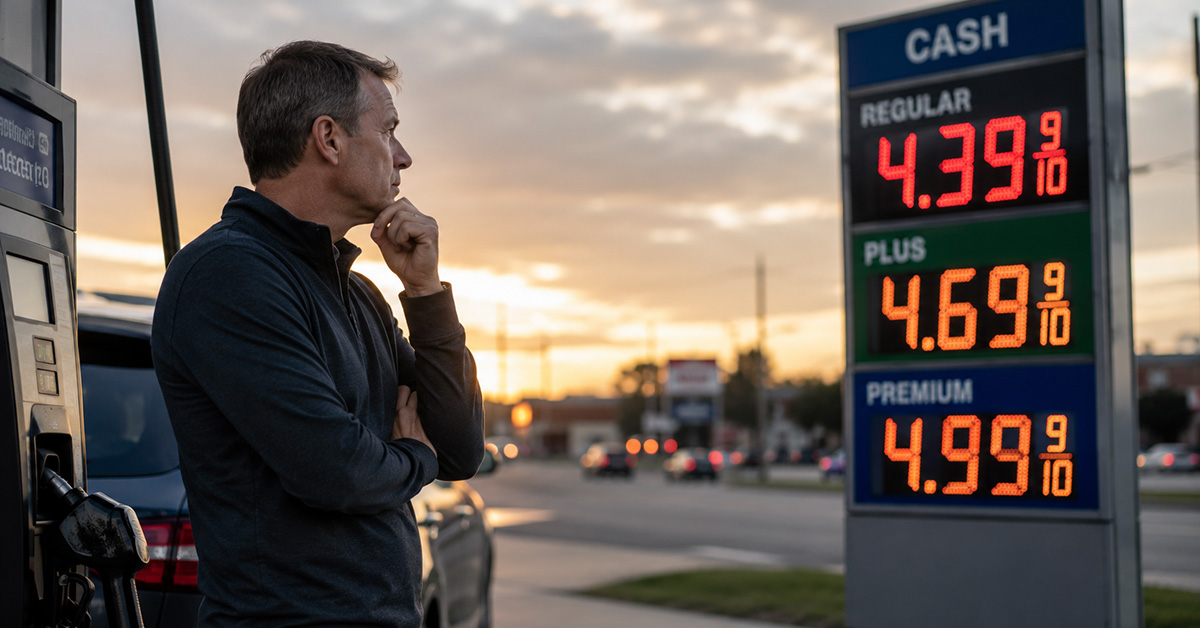
Gasoline prices rise like rockets and fall like feathers. Anyone with a car that runs on gas recognizes the pattern: by the time you fill up after reading the headlines, prices at the pump have gone up. Sometimes the prices rise the same day.
It’s not arbitrary, it’s not a conspiracy, and while it can be frustrating, it’s not unfair. It’s how the system is designed to work; a feature, not a bug.
Crude oil (and other energy products) are traded on futures markets, and energy prices react in real time. A geopolitical headline, a disruption in shipping, or a shift in supply expectations can move crude prices instantly. Retail gasoline prices, sitting downstream, follow within days.
LIFO: An Acronym That Matters
Because the energy sector uses Last In/First Out (LIFO) accounting standards, refiners and distributors price fuel based on what it will cost to acquire the next barrel, not what they paid for the last one. And there’s more to the story: gas stations operate on low inventory, meaning their costs can change quickly.
When crude prices fall, the process is different. Higher-cost inventory must be sold first. Prices adjust more slowly as that inventory clears. The result is an asymmetry that feels wrong, but is entirely logical.
This dynamic matters beyond the gas pump. It reflects how markets process risk. Prices move quickly when uncertainty increases and more gradually when that uncertainty fades. The same pattern can be observed in commodities, equities, and even interest rates.
For investors, the lesson is simple. Markets are forward-looking in moments of stress and patient in moments of resolution. Understanding that distinction helps separate reaction from strategy, and it can help an investor avoid common behavioral problems.
What happens at the gas pump is not unique. The same forward-looking behavior shows up across financial markets, including stocks. When oil prices rise, investors often assume markets will fall. Sometimes they do, and sometimes they don’t. The difference lies in why oil is rising. In periods of strong economic growth, oil prices often move higher alongside equities.
Learning From History
From 2003 to 2007, for example, crude oil rose from roughly $30 per barrel to over $140. At the same time, the S&P 500 nearly doubled. In that environment, higher oil prices were not a warning sign. They were a reflection of demand, of expanding economies consuming more energy. Oil was rising because the economy was strong.
At other times, the signal is very different. When oil rises due to supply constraints, geopolitical conflict, production cuts, or disruption to global shipping, the impact on markets tends to shift.
Higher energy costs begin to compress margins. Inflation pressures build. Central banks respond. And over time, equities often struggle under the weight of those second-order effects.
The 1970s oil embargo, the Gulf War in 1990, the 2008 spike, and the 2022 energy shock all share this pattern. Oil moved higher not because growth was accelerating, but because supply was constrained.
In those moments, oil is no longer reflecting strength. It is revealing stress. That distinction is subtle, but critical. Oil does not move markets in one direction. It reveals the condition of the system underneath.
Today’s environment offers a real-time example. Over the past year, oil prices have risen sharply on geopolitical tensions, yet equities have done well. As of May 7th, the S&P 500 was up 8% year to date. This suggests investors may be interpreting the current move as temporary; a risk premium tied to uncertainty rather than a structural shift in supply.
If that interpretation proves correct, history suggests the effects may be more limited than headlines imply. For investors, the takeaway is not to predict where oil goes next. It is to understand why it is moving. Because the reason matters far more than the price itself.